All bonds have some form of risk but our topic in the below article is the safest form of bonds of all: Government bonds.
Government bonds are the safest form of bonds because they are a direct call on the Government’s money. If you own an Australian Commonwealth Government Bond, also known as an ACGB, then unless the Australian Federal Government has failed you will receive your money on time, and in full, on the days specified in the bond. You will receive coupon payments on coupon days and the final principal back on the maturity date. Nothing in financial markets is 100% guaranteed, but the safety of a high-quality government bond is as close to guaranteed as it gets.
There are other forms of governments in Australia too, of course. Collectively, the State and Territory governments are known as the Semi-Governments, or semis for short. These Semi-Governments are not considered quite as safe as the federal government but are still incredibly safe bonds.
The features of a Commonwealth Government Bond
An ACGB is a bond and so has all the features you would normally recognise a bond as having (other than credit risk).
When you have purchased a Government bond, the size of the investment you have made is referred to as the face value. Investors will be entitled to coupons on a periodic basis for the life of the bond. For Australian fixed-rate Government bonds that is a semi-annual (i.e. each six months) coupon. Notice that the coupon you receive for each half year is half the nominated annual coupon. For example, a 5% coupon government bond will pay a 2.50% coupon every six months.
The Government bond will have a nominated maturity date and on that maturity date you will receive back your original face value along with your final coupon payment.
The Australian federal government issues two types of bonds. They issue semi-annual, fixed-rate, nominal bonds as the bulk of their issuance. They also issue inflation-indexed bonds where the face value of the bond rises with inflation. In these inflation-indexed bonds the coupon is paid quarterly. The Australian Federal Government does not issue floating rate notes at present, although there is no legal reason they could not. The Government has simply chosen not to at this point.
One interesting feature of the bonds is that they do not have a large minimum parcel size like most corporate bonds. For government bonds the official minimum trade size in the broader market is $1000, though FIIG only trades in sizes of $10,000.
Australian government bonds are incredibly liquid with the wholesale markets frequently trading hundreds of millions of dollars in a single transaction. When a new government bond is issued the initial transaction is frequently $10 billion or more. The government will also periodically hold tenders which are usually in the size of $500 million to $1 billion dollars.
A recent development is that the Australian Commonwealth Government now also issues “green” bonds. These are bonds where the cash is quarantined and only used for investments which are environmentally sustainable in nature. There are currently two green bonds on the Government curve: the June 2034 and the March 2036.
What risks there are – and what risks there aren’t – in Government bonds
On the topic of risk, the most important observation to make is that Australian Commonwealth government bonds have essentially zero credit risk. This is not true of all Sovereign government bonds because almost all countries issue bonds, but not all Governments are as stable as Australia's.
There have been defaults in government bonds in other countries; most notably in Russia in 1998 and in Argentina in 2001, 2014 and 2020. There was also a bout of severe concern about some of the smaller and more peripheral European countries in the early 2010s, most notably Greece. However, thanks to the intervention of the ECB, no defaults occurred. We should note that when a government bond does default the process is slightly different to a corporate default. Since the Government is the Government you can't easily take it to court. Instead, what normally happens is a restructuring of debt where the Government negotiates with the largest creditors to redefine the amounts owed and the time frames that will apply.
Although there is no credit risk in Government bonds, there are other forms of risk. Government bonds can have very long maturities and so can have significant duration risk. Investors who buy a fixed rate bond are locking in a return for the duration of the bond. That return is known as the yield and the market price of that yield will change each day. Australian Government Bond Investments held to maturity will give the advertised yield - but this is only true if the investment is held to maturity. At present, there are government bonds available with maturities of ~30 years.
It is possible that an investor who buys a government bond, but later chooses to leave the investment early, will make a loss because of the changes in yields. We should point out that a gain is possible too – but the important point is that the near-guaranteed return only applies if you hold the bond until maturity.
There are some other types of risk in Government bonds, but these are very much second-order compared to the duration risk. Some Government bonds will have liquidity risk, though this is mainly the very longest types of bonds and most Government bonds are amongst the most liquid investments in the market. When there is a complete paralysis of markets – like the early days of COVID – it is still possible the government bonds might suffer from brief periods of illiquidity.
There are also some risks which apply to the usefulness of the return, rather than the value of the return itself. Most notable here is inflation risk. While a government bond will effectively guarantee a payment will arrive on the specific date promised, it does not guarantee that the payment will have the expected purchasing power. An outbreak of inflation undercuts the purchasing power of a supposedly guaranteed investment.
Finally, there is regulatory risk. If the government changes the rules for the taxation of bonds, then while the before-tax return may be guaranteed, the post-tax return is not. We should note that these last two risks are risks for most investments. They simply come to the fore for Government bond investments because the other forms of risk are less prominent.
If there’s almost no risk, what’s the downside?
There is very low risk in a government bond with duration risk being the most realistic risk source. Purchasing a relatively short Government bond, like a 2 year or a 3 year, largely removes the duration risk too and leaves a near risk-free investment: so what’s the catch?
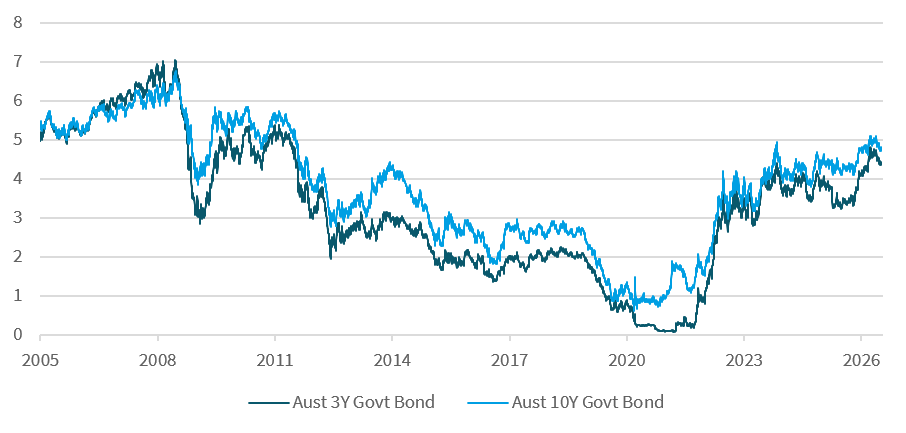
The biggest “catch” is simply that financial markets reward the taking of risk. Short-term government bonds do not have very much risk, so they don’t have very much reward either. The yields on government bonds can be very low. For almost the entire period between 2012 and 2022 the 3Y Government bond had a yield below 3%. There’s very little risk, but a lot of lost opportunity for leaving money in these incredibly safe investments. At present, with yields a little more like 4.50%, the short-term government bonds do appear to be slightly more attractive now than in the past but still lag the yields that can be earned for taking even a small amount of risk.
Figure 1: Government Bonds are very safe, but can have low yields
Source: FIIG, Bloomberg.
The Government bond market is very large and incredibly liquid most of the time. However, many of the investors in the Government bond market are not seeking to maximise returns. Instead, most investors in the Government bond market are seeking to get a small amount of return for very large investments that must remain fully liquid. For example, bank balance sheets are large owners of Government bonds. The banks are trying to earn some returns from their liquidity books, but their primary purpose is to provide the banks their reserve liquidity for periods of stress. The returns earned are nice for the banks to have but are largely an afterthought compared to the primary requirement of providing the necessary liquidity required by the regulators.
Investors in Government Bonds are, often, sacrificing higher returns that could have been earned elsewhere for an extremely high level of liquidity when liquidity is the primary consideration.
State Government Bonds – Materially higher returns, still very low risk
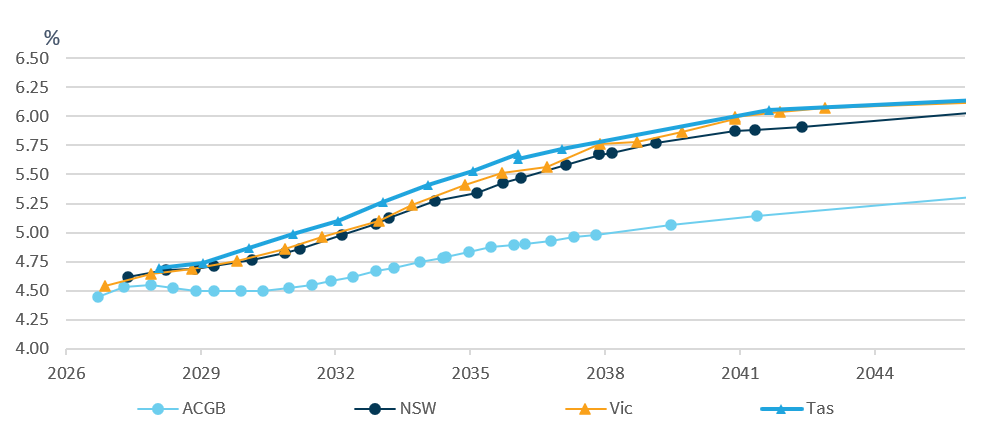
The extra yield that can be earned by purchasing a State Government bond, rather than a Federal Government bond, is surprisingly high. There is frequently an extra 60 or 70bp more yield to be had for taking the very marginal extra risk of a state government as opposed to the Federal Government.
Figure 2: State Government Bonds are still very safe, but have higher yields
Source: FIIG, Bloomberg.
The risk that NSW or Victoria might be completely bankrupt and unable to pay its debts is remarkably low. This goes back to the comments earlier about the purchasers of government debt frequently valuing other things like liquidity and safety higher than returns.
State Government bonds are fractionally less liquid and fractionally more risky than Federal Government bonds. However, there is also a materially higher yield. It is up to each investor to decide whether or not the extra yield is worth the extra risk.